
© Louis Vuitton
© Louis Vuitton
© Louis Vuitton
Louis Vuitton
In 1874, Sameshima Naonobu, Japan's minister plenipotentiary in Paris, visited Louis Vuitton to purchase trunks. He is the first Japanese client identified in the House's archives — one hundred and four years before the first store opened in Tokyo. And the Monogram canvas, created in 1896 by Georges Vuitton to protect the House from counterfeiters, drew directly from the mon, the traditional Japanese family crests, and from the Japonisme that had swept Paris since the 1867 World's Fair. The most recognisable logo in world fashion is a French creation nourished by Japanese aesthetics. Japan did not yet know it. The House had not forgotten.
The History · What Preceded The Boutiques By A Century
The relationship between Louis Vuitton and Japan begins in Paris, not in Tokyo. In 1867, Japan participated for the first time in a World's Fair — in Paris. The Vuitton family encountered the representatives of Japonisme in France and began collecting Japanese artworks. Seven years later, Sameshima Naonobu came to buy his trunks on the rue du Faubourg Saint-Antoine. In 1896, Georges Vuitton created the Monogram canvas by drawing on the Japanese graphic vocabulary — the mon, the stylised flowers, the geometric patterns that constitute the language of Japanese family crests. This canvas, registered in perpetuity, became the symbol of the House and the most copied object in world fashion. In 1978, Kyojiro Hata, an economist trained at Berkeley and Dartmouth, joined Louis Vuitton and developed over a few years a business model in Japan that would be used by every major House seeking to enter the market — the first store opened in the Kioicho district of Tokyo. Louis Vuitton became in less than a decade the most desired luxury brand in Japan. This success came from nowhere. It began in 1867, in a pavilion at the Paris World's Fair, when the Vuitton family looked at Japan for the first time.
The Water Façade · Ginza Namiki · Jun Aoki And Peter Marino
The Louis Vuitton flagship on Namiki Street in Ginza — the House's first Tokyo store since 1981, renovated in 2021 after three years of work — is the result of a collaboration between Japanese architect Jun Aoki and American designer Peter Marino that Louis Vuitton developed over several decades and several countries. Jun Aoki chose for the façade two superimposed layers of glass covered with a dichromatic film that produces iridescent reflections oscillating between pale blue and rose depending on the angle and the light — a surface that imitates the surface of water, undulating, shifting, never identical to itself. At night, the façade glows. By day, it reflects. In both cases, it makes the boutique perceptible from a distance in an environment where everything competes for attention. Peter Marino extended this logic inside — rounded angles, glass and metal partitions, mirrors and lights that create depth and reflections, a central staircase in pale oak with a pale blue handrail. At the top of the building, Café V and Chocolat V, with chef Yosuke Suga.
The Ginza Namiki flagship is the founding address of Louis Vuitton in Tokyo — the building that has occupied a strategic street corner in the capital's most dense luxury district for forty years. Its 2021 renovation did not seek to erase forty years of history but to reformulate them in a contemporary architectural language — Jun Aoki's iridescent façade is simultaneously a reference to water, omnipresent in the Japanese imagination, and a proposition about what the façade of a luxury boutique can do in a visually saturated environment: not impose itself through colour or signal, but shift according to what is happening around it, like a natural surface. Peter Marino's interior deploys the fashion, leather goods, accessories and jewellery collections across four retail levels, with a private salon and the Café V and Chocolat V spaces at the summit.
The Omotesando address is the neighbourhood Louis Vuitton boutique — the one frequented by residents of Minami-Aoyama and Harajuku in a quieter, more residential environment that more closely resembles the way Tokyo lives luxury on a daily basis rather than on occasion. Jun Aoki designed for this address a Soft Damier façade — the House's Damier motif translated into curves rather than right angles, an adaptation of the graphic code to the Japanese context that says something about the way Louis Vuitton thinks its boutiques in Japan: not uniform, but calibrated to their precise environment.
Jonathan Anderson was appointed sole artistic director of all Louis Vuitton collections in 2025 — overseeing womenswear and menswear simultaneously. His first mixed collection, presented in 2025 in Paris, was accompanied by the first mixed campaign in the House's history. Anderson arrives at Vuitton with a reading of leather goods and clothing that privileges material over logo, construction over decoration, the intelligence of the gesture over the spectacularity of the concept — a reading that the Japanese clientele, which knows how to distinguish these things, receives with the same precision as it reads a saddle stitch at Hermès or a tweed at Chanel. The Ginza Namiki and Omotesando boutiques present these collections in spaces whose architecture was conceived for the same register: discreet in appearance, dense in content.
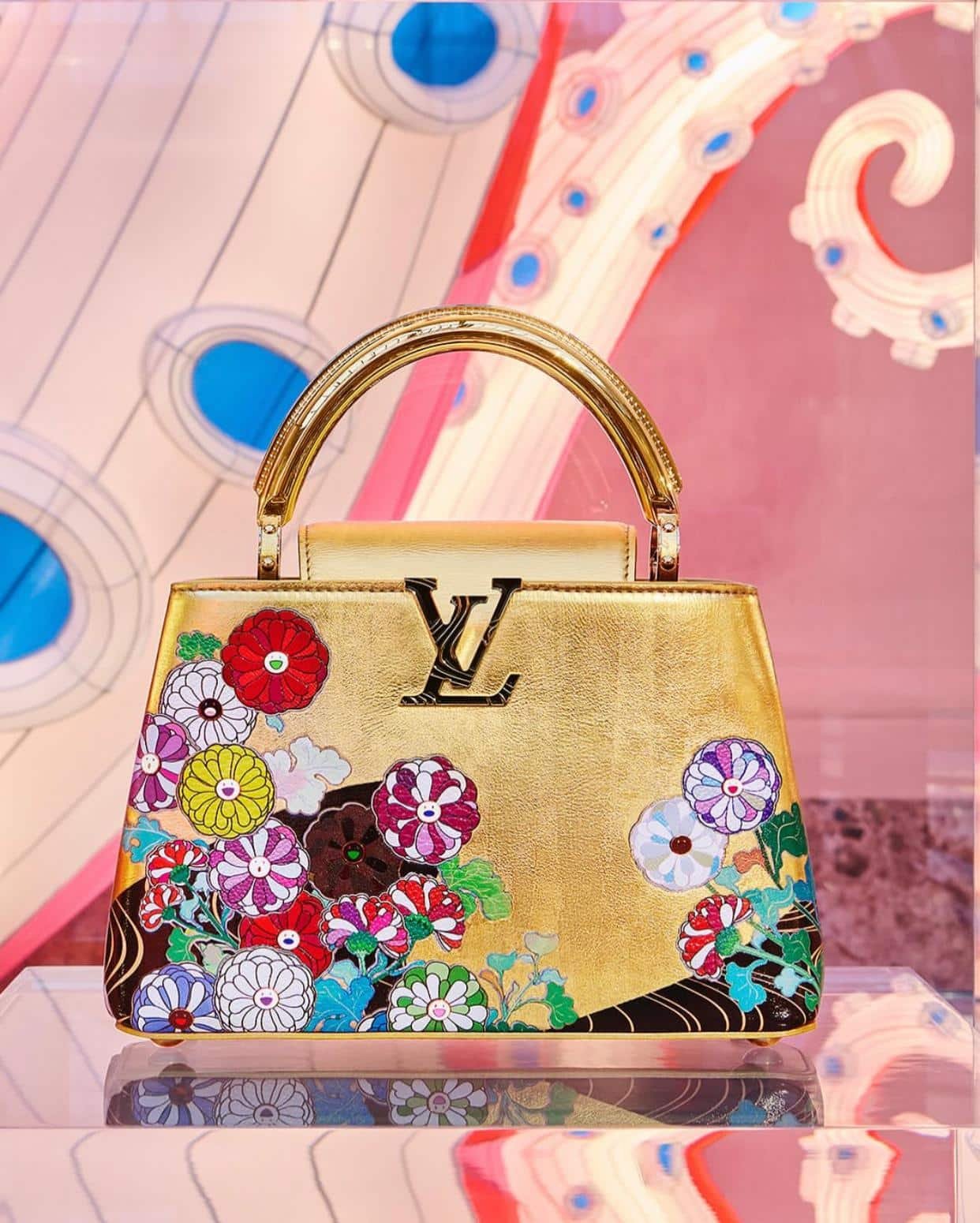
Marc Jacobs' collaboration with Takashi Murakami in 2002 — Monogram Multicolore, Monogramouflage, Monogram Cosmic Blossom — was Louis Vuitton's first official collaboration with a Japanese artist. It was followed by collaborations with Yayoi Kusama, Hiroshi Fujiwara, Nigo, Kansai Yamamoto, and references to Japan in the collections of Virgil Abloh, Kim Jones and Nicolas Ghesquière. This continuity is not a marketing strategy. It is the logical consequence of a fascination that dates to 1867 — when the Vuitton family looked at Japan for the first time at the Paris World's Fair and decided to retain something from it. The Monogram carries in each LV interlaced with a stylised flower the memory of that Japanese pavilion, a hundred and fifty years before Murakami reinterpreted it in colour.
On the occasion of the 2025 Osaka World's Fair, Louis Vuitton presented Visionary Journeys at the Nakanoshima Museum of Art — a twelve-chapter exhibition retracing a hundred and seventy years of the House's history through more than a thousand objects, two hundred of which were specifically linked to Japan. Florence Müller presented for the first time the portrait of Sameshima Naonobu, loaned by the Komaba Museum in Tokyo, alongside his entry in the 1874 client accounts book. The architecture was by Shohei Shigematsu, OMA — the sample from the Monogram canvas trademark registration at the centre of a circular room surrounded by Monogram bags from every era. The Monogram at the centre of its own history, in the country whose aesthetics inspired it.
Jun Aoki is the Japanese architect Louis Vuitton has commissioned to design virtually all of its façades in Japan for two decades. Trained at the University of Tokyo and under Arata Isozaki, he has developed for the House an architectural vocabulary that translates Vuitton's visual codes — Damier, Monogram, trunks — into forms that are legible in Japan without being folkloric. The Ginza Namiki façade imitates water. The Osaka Midosuji façade imitates the sails of Higaki-Kaisen ships. The Matsuya Ginza façade renders the Damier in Art Deco curves. Each façade responds to its precise location — the same attitude as that of Georges Vuitton in 1896 when he looked at the Japanese mon and decided they could become the Monogram.
In 1867, Japan held its first pavilion
at the Paris World's Fair.
The Vuitton family began collecting
Japanese artworks.
In 1874, Sameshima Naonobu
came to buy trunks on the rue du Faubourg Saint-Antoine.
In 1896, Georges Vuitton created the Monogram
inspired by Japanese family crests.
In 1978, the first store opened in Tokyo.
In 2002, Takashi Murakami reinterpreted the Monogram.
In 2025, the Osaka exhibition
presented for the first time
the portrait of the first Japanese client.
The Monogram was Japanese
before Japan knew it.
There is something precisely right in the fact that Japan is one of the markets where Louis Vuitton is most present, most frequented and most deeply understood, given that the object which defines the House in the eyes of the entire world — the Monogram canvas — is a French creation inspired by Japanese aesthetics. Japan recognises in the Monogram something it has already seen in its own graphic traditions, without having named it as such. Jun Aoki's iridescent façade at Ginza Namiki, which shifts colour according to angle and light like a water surface, is the 2021 version of the same decision Georges Vuitton made in 1896: to look carefully at Japan, and to retain something precise from it.
Louis Vuitton Ginza Namiki
Namiki-dori, Ginza, Chūō-ku, Tokyo
Jun Aoki · Peter Marino · 2021 · 7 floors
Café V · Chocolat V · Chef Yosuke Suga
Louis Vuitton Omotesando
Omotesando, Minami-Aoyama, Shibuya-ku, Tokyo
Jun Aoki · Soft Damier façade
A Japanese diplomat who came to Paris in 1874
to buy trunks.
A logo created in 1896
inspired by Japanese family crests.
An iridescent glass façade on Ginza
that imitates the surface of water.
A Murakami who reinterpreted the Monogram
a hundred and twenty years after it was created.
Japan and Louis Vuitton
have been watching each other since 1867.
They are not finished.
© Louis Vuitton
© Louis Vuitton
© Louis Vuitton
© Louis Vuitton
© Louis Vuitton
© Louis Vuitton
© Louis Vuitton
© Louis Vuitton
© Louis Vuitton
© Louis Vuitton
LOUIS VUITTON
© Louis Vuitton