
© Cartier
© Cartier

© Cartier
Cartier
Louis Cartier never set foot in Japan. Yet he was one of the most passionate collectors of Japanese art in Paris — prints, lacquerwork, inrō, decorative objects — a personal collection that directly inspired some of the House's most important pieces. The 1923 Portique clock, whose form in rock crystal, diamonds and onyx precisely reproduces a torii, the gateway of a Shinto shrine. The 1930 vanity case shaped as an inrō, the small box suspended from the belt of the male kimono. The fully articulated wisteria cluster earrings, drawn from the journal Le Japon Artistique published by the merchant Samuel Bing. Louis Cartier's Japan was not a destination. It was a library.
The History · A Collector Who Never Went There
In 1867, at the Paris World's Fair, Japan presented its objects to the Western world for the first time — objects selected directly by the Tokugawa shogunate. Louis Cartier, son of founder Alfred, was sixteen years old. The fascination was immediate and lasting. He assembled a collection of Japanese art that would permeate his eye and, through his eye, the House's creations for decades. He read the journal Le Japon Artistique published by Samuel Bing — the merchant who was one of the great conduits of Japonisme in France — and found there the wisteria clusters, symbol of youth, which he reinterpreted as fully articulated diamond earrings. The first jewels in the Japanese style date to 1877. The Japanese brooch of 1907 — platinum, diamonds and rubies whose interlaced lines form a traditional Japanese knot — is one of the most documented pieces of that period. The 1923 Portique clock, whose form in rock crystal, diamonds and onyx precisely reproduces the gateway of a Shinto temple, is the piece that best summarises what Louis Cartier's fascination with Japan produced: not a superficial decoration, but a precise architectural reading of a sacred form, translated into the materials of fine jewellery. His personal collection was dispersed in 1962. Photographs taken in 1936 show what inspired him. The Musubi exhibition, presented at the Tokyo National Museum in 2024 to mark fifty years of Cartier's presence in Japan, brought these pieces together in their original context for the first time.
Asia's Largest Flagship · Ginza · Seigaiha · 2025
In September 2025, Cartier inaugurated its largest flagship in Asia at the heart of Ginza — four floors in the Hulic Ginza Sukiyabashi Building, exactly fifty years after the first boutique opened in Japan in 1974. The façade, designed by the Tokyo-based agency Klein Dytham Architecture, draws from the seigaiha motif — the waves of the blue ocean, a traditional Japanese pattern whose interlocking semicircles evoke fish scales or successive waves. Curves that contrast with the linearity of Ginza's architecture, creating an effect of depth and volume that straight geometric forms do not produce. The interior, by Bruno Moinard and his Moinard Bétaille agency — which has overseen Cartier interiors since 2002 — weaves a Franco-Japanese dialogue in every detail: washi paper, natural wood and stone alongside Versailles-pattern parquet; ceilings inspired by the folds of origami; a sculptural staircase rising beside an orchid-petal bar. On the ground floor, a monumental work by Eriko Horiki — a Japanese artist specialising in washi paper — depicts a Panthère moving through a forest, composed of four layers of handcrafted paper whose depth and transparency shift with the light.
The Ginza 4-Chome flagship is conceived as a residence rather than a shop — the metaphor of a private house where each room has its own identity and its own programme. The ground floor is dedicated to the Panthère, with Eriko Horiki's monumental washi work and spaces for the iconic collections. The second floor, entirely devoted to diamonds and bridal creations, is crowned by a ceiling whose forms evoke kites in flight — curves and ellipses in harmony, with decorative panels of ginkgo leaves, symbols of vitality and peace. The Salon Japonesque presents works by artist Ryo Hikosaka inspired by a 1907 Cartier diamond brooch with abstract geometric motifs — the conversation between the House and Japan that dates to Louis Cartier, made visible in a space dedicated to this dialogue. The Quick Care Service Bar, designed with orchid petal motifs — a symbol of prosperity — offers immediate service in a setting that treats maintenance as an act of care rather than a constraint.
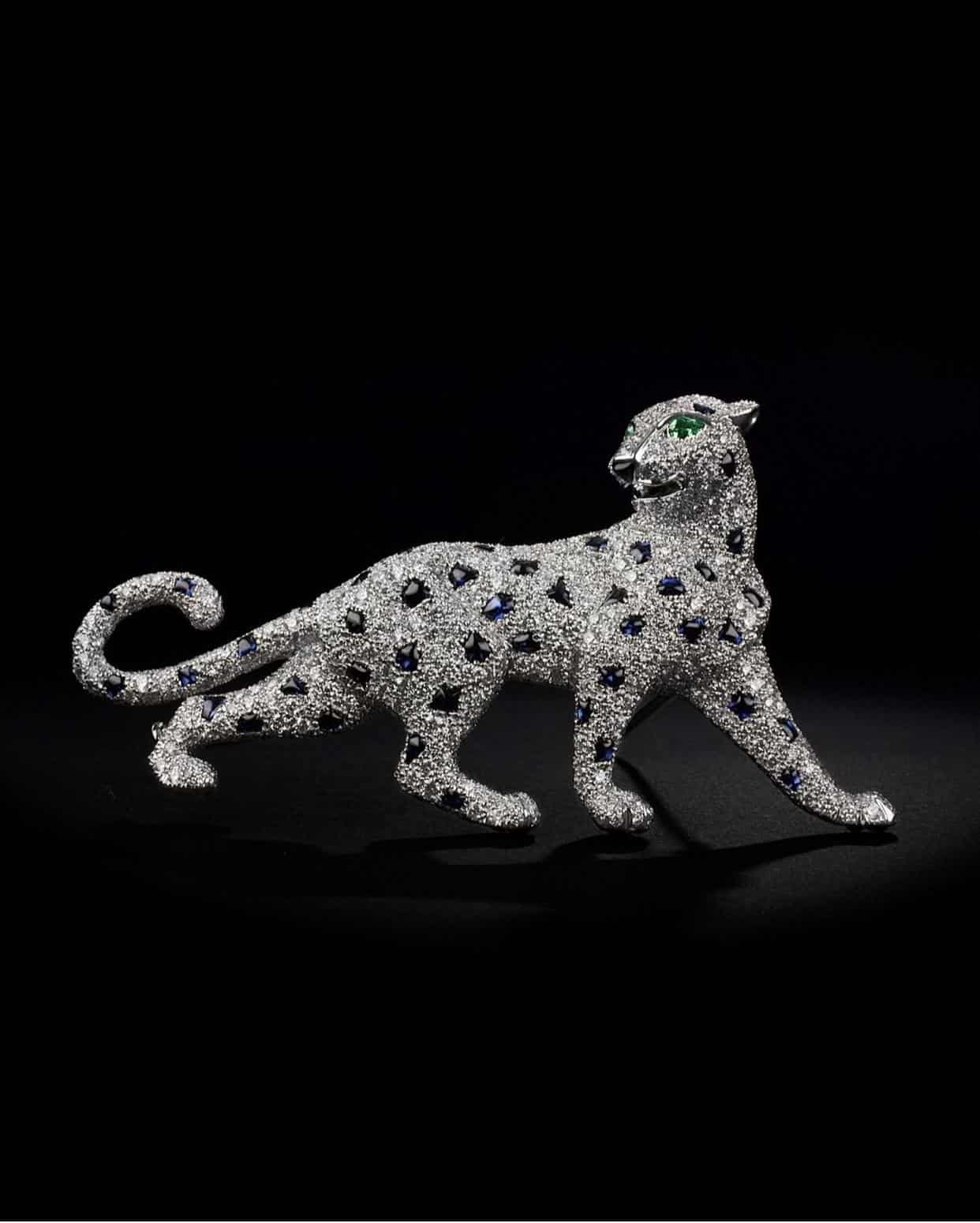
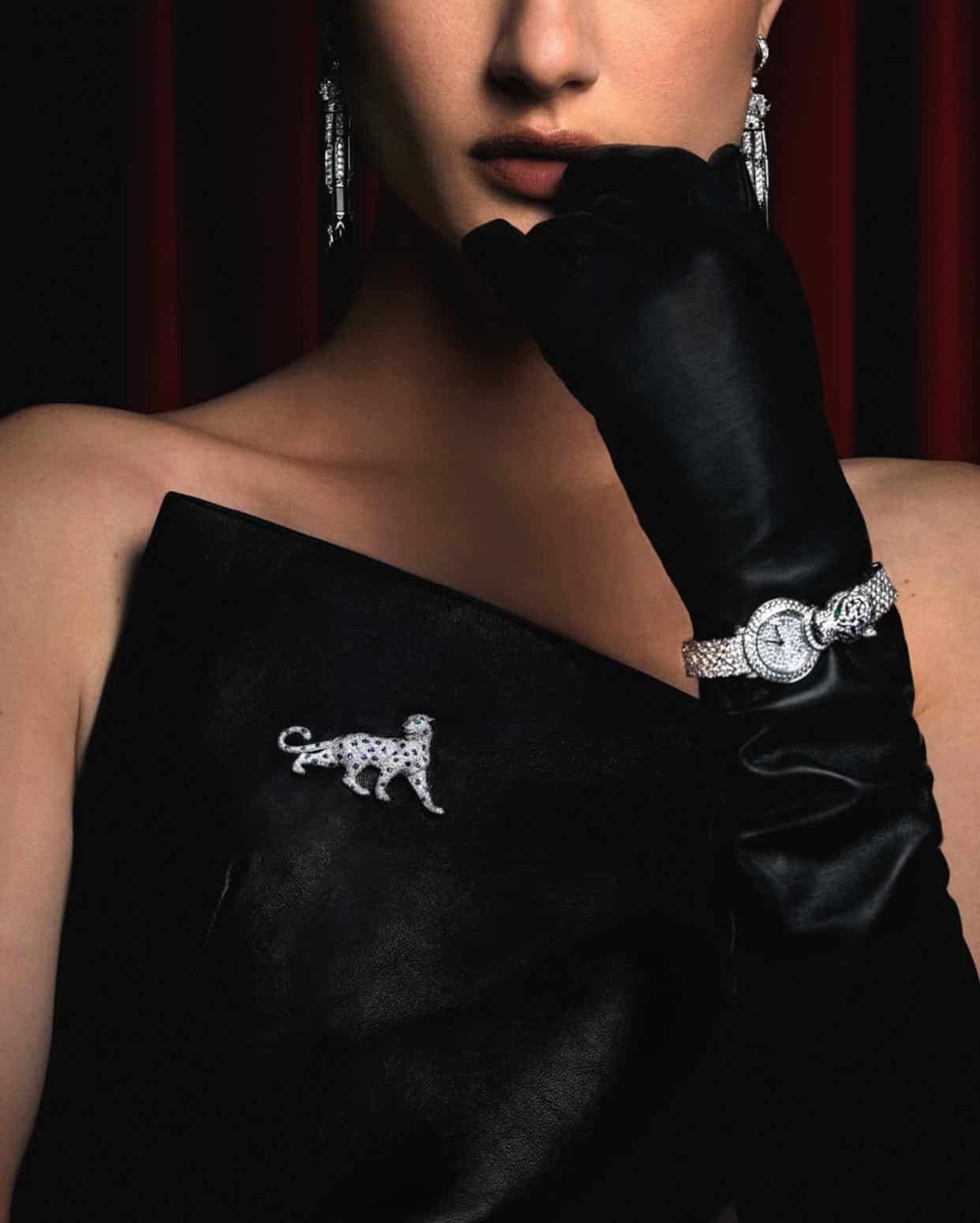
The Cartier fine jewellery presented in Tokyo operates in the register that has belonged to the House since the era of Jeanne Toussaint — the Panthère as the central figure, the animal that has moved through the collections since the first brooch of 1914, which was worn by the Duchess of Windsor on a 152.35-carat cushion-cut Kashmir sapphire and which continues to inhabit the contemporary fine jewellery collections in forms that Toussaint would not have immediately recognised but would have understood. The Japanese fine jewellery clientele reads the Cartier collections with particular attention to coloured stones — the sapphires, emeralds and rubies to which the House has always accorded equal standing alongside white diamonds — and to the architectural constructions of transformable pieces, direct inheritances from the Art Deco period when jewels could be worn in several ways. These are precise readings that correspond to what the House has produced at its most considered. Tokyo receives them without needing them to be explained.
The Musubi exhibition — the Japanese word meaning bond, connection, knot — was presented at the Hyokeikan of the Tokyo National Museum in 2024 to mark the fiftieth anniversary of Cartier's presence in Japan. The Hyokeikan, built in 1908 in the Western style, is the oldest art museum in Japan built in the Western manner — an architecture that itself carries the dialogue between the two cultures. The exhibition brought together the pieces inspired by Japan from the very beginning — the knot brooch of 1907, the 1923 Portique clock whose crystal portal reproduces a torii, the inrō-shaped gold and lacquer vanity case of 1930, the cherry blossom bracelet of 1925 — and the documents that allow one to understand how Louis Cartier, from Paris, without ever crossing the ocean, built a Japanese imagination precise enough to produce these objects. The second part of the exhibition documented the contemporary dialogue — the Japanese photographers exhibited at the Fondation Cartier in Paris, Daido Moriyama in 2003 and 2016, Nobuyoshi Araki, and the creation in return by these artists of pieces that respond to the House from their own tradition. A dialogue in both directions, across a hundred and fifty years.
Beyond the Ginza 4-Chome flagship, Cartier is present in Tokyo across several dedicated boutiques and department store spaces that ensure the House's presence in the city's different districts. The Ginza Namiki-dori boutique — the street that concentrates several of the most important luxury addresses in Tokyo — offers the permanent collections in a more intimate format than the flagship. The spaces at Isetan Shinjuku, Matsuya Ginza and Mitsukoshi Nihombashi allow the House to be present within the great Japanese distribution structures — the department stores where Japanese clients have historically discovered and adopted the great international Houses since the nineteen-sixties and seventies. This network says something about how Cartier thinks its deployment in Japan: a flagship as the reference and fine jewellery address, boutiques and neighbourhood spaces as daily presences in the life of the city.
The 1923 Portique clock is the piece that best summarises what Louis Cartier's fascination with Japan produced in terms of creation. Its form in rock crystal, diamonds and onyx is not a distant evocation of Japanese architecture — it is the precise reproduction of a torii, the monumental gateway that marks the entrance to a Shinto shrine, the boundary between the ordinary world and sacred space. Louis Cartier had studied these portals in his collection of Japanese photographs and prints. He asked his ateliers to build a clock that would be a torii — and the ateliers responded by producing an object whose crystalline structure simultaneously evokes the transparency of rock and the light that passes through shrine gateways at sunrise in Japanese forests. This piece is today in the House's heritage collection. Its existence — made in Paris in 1923 by a man who never saw a torii in person — is proof that fascination, when it is precise and documented, produces something more faithful than travel.
The Fondation Cartier pour l'art contemporain, founded in Paris in 1984, has since its creation presented a significant programme of Japanese artists that extends the dialogue begun by Louis Cartier in 1867. Daido Moriyama — one of Japan's most important photographers, whose black-and-white images of Tokyo and Japanese cities define an aesthetic of the contemporary city — was exhibited at the Fondation in 2003 with two hundred photographs and more than three thousand Polaroids, then invited again in 2016. Yukio Nakagawa, a pioneer of contemporary ikebana, presented as early as 1998 floral compositions whose provocative and erotic use of plant matter transformed the tradition of Japanese floral art into a contemporary gesture. This relationship between the Fondation and Japanese artists has produced in return works that respond to the House — such as Ryo Hikosaka's pieces in the new Ginza flagship, inspired by the 1907 Japanese brooch. The conversation has been going on for a hundred and fifty years. It is not finished.
Louis Cartier never set foot in Japan.
Yet he was one of the most passionate
collectors of Japanese art in Paris.
In 1923, he asked his ateliers
to build a clock
in the shape of a torii —
the gateway of a Shinto shrine.
They did.
In rock crystal, diamonds and onyx.
Fascination, when it is precise,
produces something more faithful
than travel.
In 2025, Asia's largest Cartier flagship
opens on Ginza
with a façade of Japanese waves.
Fifty years after the first boutique.
A hundred and fifty years after the World's Fair.
The dialogue continues.
Cartier's relationship with Japan is the most complete demonstration of what aesthetic fascination can produce when it is rigorous rather than decorative. Louis Cartier did not use Japan as a repertoire of exotic motifs to apply to Parisian jewels. He studied Japanese forms — the knots, the gateways, the inrō, the wisteria clusters — with the precision of an architect seeking to understand the constructive logic before proposing a translation. The Portique clock is a torii in crystal, not an evocation of a torii. The vanity case is an inrō in gold and lacquer, not an object decorated with Japanese motifs. This precision is what the Japanese fine jewellery clientele recognises when it enters the Ginza 4-Chome flagship — a House that has looked at Japan attentively for a hundred and fifty years, and whose every object carries the trace of that gaze. The Musubi dialogue — the knot, the connection — between Cartier and Japan is not a marketing celebration. It is the right name for a relationship built piece by piece, since a World's Fair in Paris in 1867, by a man who never went to see what fascinated him.
Cartier Ginza 4-Chome · The 2025 Flagship
Hulic Ginza Sukiyabashi Building · Ginza, Chūō-ku, Tokyo
Klein Dytham Architecture · Seigaiha façade
Bruno Moinard Bétaille · Interiors
Eriko Horiki · Washi Panthère · Ryo Hikosaka · Salon Japonesque
Cartier Ginza Namiki-dori
5-5-15 Ginza, Chūō-ku, Tokyo
A man who never went there
built a clock in the shape of a torii.
In rock crystal.
In 1923.
A hundred years later,
Asia's largest Cartier flagship
opens on Ginza
with a façade of Japanese waves.
The Panthère moves through a washi forest
on the ground floor.
A Japanese artist responds
to a 1907 brooch
in the Salon Japonesque.
Louis Cartier watched Japan
from his Parisian library.
Tokyo has been returning the gaze
for a hundred and fifty years.
© Cartier
© Cartier

© Cartier
© Cartier
© Cartier

© Cartier

© Cartier

© Cartier
© Cartier
© Cartier
CARTIER
© Cartier