
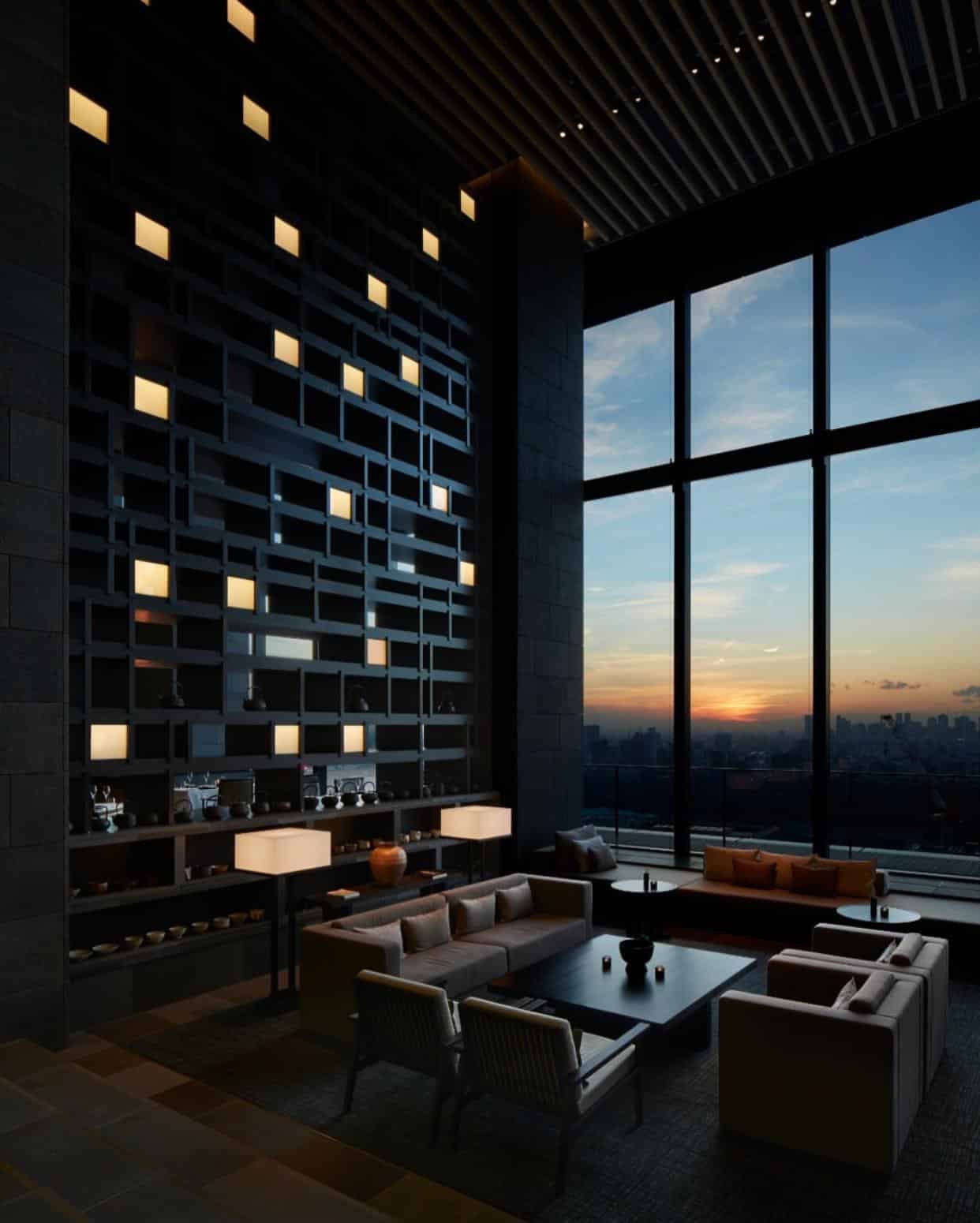
© Aman Tokyo

© Esquisse

© Dior
The City Has Been Counting Since 2010
In April 2010, the Tokyo Metropolitan Government launched the world's first urban cap-and-trade programme — a mandatory emissions trading scheme covering large commercial and industrial buildings across the city. Not the first in Asia. The first in the world. No other city had imposed binding carbon reduction targets on its office buildings through a market mechanism before Tokyo did. The programme covers approximately 1,300 facilities — office buildings, factories, public institutions — whose emissions account for forty percent of the commercial and industrial CO2 produced in the metropolitan area. The buildings on Ginza, where the flagship boutiques of the world's great luxury groups operate, are subject to these constraints. They have been since 2010. The luxury industry has been operating inside a carbon accounting framework in Tokyo for fifteen years.
The Context · The City · Buildings As The Central Problem
Tokyo is a city of buildings. Its commercial and residential stock is among the densest in the world, concentrated across an urban area of 2,194 square kilometres inhabited by over fourteen million people. Buildings consume approximately seventy percent of the city's total energy — a figure that makes the built environment the primary lever of any serious emissions reduction strategy. The Tokyo Metropolitan Government understood this in 2008, when it began designing the cap-and-trade programme that would launch in 2010. The logic was simple and had not been applied anywhere before: if buildings are the source of the emissions, hold buildings accountable. The scheme requires covered facilities to reduce their CO2 emissions below their historical baseline, with compliance factors that tighten across each five-year period. By the end of the second compliance period in 2019, covered buildings had reduced their emissions by twenty-seven percent against baseline. The fourth compliance period, running from 2025 to 2029, requires a fifty percent reduction. The luxury boutiques of Ginza and Marunouchi operate inside this framework. Their energy consumption is monitored, reported, and verified annually by third parties.
The GX Policy · The National Framework · The Law That Is Already Moving
In February 2023, the Japanese Cabinet approved the Basic Policy for the Realization of GX — Green Transformation — a national strategy targeting one hundred and fifty trillion yen in public-private investment over ten years to decarbonise the Japanese economy. The GX Promotion Act was enacted by the Diet the same year. The strategy establishes a GX League — a voluntary emissions trading system that became operational in October 2023 and will transition to mandatory participation from fiscal 2026 — and introduces a carbon levy beginning in 2028. Japan has committed to reducing greenhouse gas emissions by forty-six percent below 2013 levels by 2030 and achieving carbon neutrality by 2050. The GX framework does not directly target the fashion or luxury industry as a named sector. What it does is establish a national carbon pricing architecture within which every major company operating in Japan will be required to account for its emissions — including the holding groups whose boutiques occupy the most expensive commercial real estate in Ginza. The obligation is not yet fully formed. It is forming. The companies that have already begun to measure and reduce will have less to manage when it arrives than those that have not.
Kering introduced in 2011 a tool that most companies — luxury or otherwise — have not adopted even in 2025: the Environmental Profit & Loss Account, a methodology that translates the environmental impacts of the entire supply chain into monetary values, making visible the true cost of each material, each process, each sourcing decision. The EP&L reveals what standard carbon inventories do not show: the actual footprint of a leather bag measured from the animal's pasture to the boutique shelf, the cost of a dyed silk calculated from the water consumed in the dyeing vat. In Japan, Kering has taken a further step: it launched the Kering Generation Award in partnership with CIC Tokyo, offering a ten million yen prize to startups innovating in sustainable fashion and beauty — an institutional gesture toward the Japanese innovation ecosystem that the group's houses operate within. Gucci Equilibrium, the house's impact programme, applies directly to the collections and operations in Tokyo's boutiques.
LVMH launched in 2020 the LIFE 360 programme — Life In terms of Fashion and the Environment — with quantified targets across three horizons: 2023, 2026, and 2030. The programme's four pillars — creative circularity, biodiversity, climate action, and supply chain traceability — apply to every house in the group, including those with boutiques on Ginza and Omotesando. LVMH is a member of the TNFD — the Taskforce on Nature-related Financial Disclosures — the international body responsible for developing standards for evaluating and communicating biodiversity-related risks in corporate financial reporting. This membership is not decorative. It is a commitment to the proposition that the health of natural ecosystems is a material financial risk for companies whose supply chains depend on them — which, in the case of a group producing leather goods, fine jewellery, and haute couture from natural materials, is self-evidently true. Tiffany & Co., fully integrated into the LIFE 360 framework since its acquisition, has strengthened its responsible sourcing commitments for diamonds and precious metals — a category whose extraction chains are among the most environmentally documented in the luxury industry.
In March 2006, ten volunteers brought thirty thousand bees to the rooftop of the Pulp and Paper Hall building in Ginza — a building four minutes' walk from the Hermès flagship, six from Chanel. The Ginza Honey Bee Project, known as Ginpachi, was not a sustainability initiative designed for a corporate audience. It was a local community project whose founding question was simple: can you keep bees on a rooftop in the middle of Tokyo? The answer turned out to be yes — because within a three-kilometre radius of Ginza are the Imperial Palace gardens, Hibiya Park, and Hama-rikyu, each providing nectar sources that the urban bees, less exposed to pesticides than their rural counterparts, could exploit year-round. Today Ginpachi manages three apiaries in Ginza and two in Marunouchi, with a peak population of two hundred and fifty thousand bees producing more than two tonnes of honey annually. The honey is distributed exclusively within the local ecosystem — to Ginza hotels, restaurants, bars, and department stores, including Matsuya, where staff who participate in the harvesting can explain directly to customers where the product comes from. This is not a communication strategy. It is a neighbourhood deciding that its rooftops are not wasted space.
Japan has set a national target of seventy percent textile recycling by 2030 — a commitment that places it significantly ahead of most economies in articulating a quantified circular fashion objective. The target is supported by a cultural precondition that no European or American market can replicate by policy alone: the Japanese concept of mottainai — the sense of regret at waste, the instinct to extract full value from every object before discarding it — functions as a structural consumer orientation toward longevity and quality over volume and replacement. Japanese luxury consumers have historically selected purchases on the basis of durability and craftsmanship rather than trend velocity; the department store buyers who curate the fashion floors of Isetan Shinjuku and Mitsukoshi Ginza apply the same editorial rigour to sustainability credentials as they apply to aesthetic quality. A house that cannot demonstrate the durability of its materials in this market faces a form of scrutiny that no marketing campaign can manage. The seventy percent recycling target gives that scrutiny a national number.
The Tokyo Metropolitan Government published the Zero Emission Tokyo Strategy — a comprehensive plan targeting net zero CO2 emissions by 2050 and a fifty percent reduction in both emissions and energy consumption compared to 2000 levels by 2030. The strategy covers six key sectors: energy, buildings, transport, resources, climate adaptation, and public engagement. From 2025, all new residential and commercial buildings in Japan must comply with upgraded energy efficiency standards — the first time the regulatory baseline for new construction has been raised to zero energy building standard. The fourth compliance period of Tokyo's cap-and-trade programme, running from 2025, requires covered buildings to reduce their emissions by fifty percent against their historical baseline — a target that applies directly to the large commercial facilities on Ginza and in Marunouchi where the luxury houses maintain their flagship boutiques. The city is not asking. It is requiring. And the requirement has been in force, in progressively more demanding form, since 2010.
At Gloss Tokyo, we do not publish sustainability rankings or emissions performance leaderboards. We do not award recognition for recyclable packaging or carbon-neutral declarations whose perimeters are defined by those who publish them. That is not our role. What we do — look closely. Tokyo has been operating the world's first urban cap-and-trade scheme since 2010. The city has set binding fifty percent emissions reduction targets for its commercial buildings. It has committed to zero net emissions by 2050. It has a cultural framework — mottainai — that precedes regulation by centuries and produces a consumer class that evaluates the durability of a purchase before its appearance. The houses that will be able to meet the obligations of the GX framework when it fully arrives are those that have already begun to measure, trace, and reduce. The Ginza Honey Bee Project started with thirty thousand bees and a rooftop in 2006. It now produces two tonnes of honey per year from the nectar of the Imperial Palace gardens. The city does not wait for permission to begin. Neither do we.
In April 2010, Tokyo became
the first city in the world
to impose binding carbon reduction targets
on its commercial buildings
through a mandatory trading scheme.
Not the first in Asia. The first in the world.
The boutiques of Ginza have been operating
inside that framework for fifteen years.
Above them: three hundred thousand bees
on the rooftops,
foraging from the Imperial Palace gardens,
producing two tonnes of honey
for the hotels and bars of the same district.
The city has been counting since 2010.
The question is which houses
have been counting with it.
Tokyo is not New York. There is no Fashion Act waiting in a legislative committee, no bill drafted specifically to name the luxury houses and impose supply chain mapping and emissions targets on those generating more than one hundred million dollars in annual revenue. What there is, is a city that has been imposing binding carbon reduction obligations on its commercial buildings since 2010 — fifteen years before most cities had begun the conversation. A national GX framework that will make emissions trading mandatory from 2026 and introduce a carbon levy in 2028. A seventy percent textile recycling target for 2030. And a consumer culture built on mottainai — the deeply Japanese conviction that waste is a form of disrespect, that an object is not finished until its full value has been extracted, that quality and duration are not premium attributes but the baseline expectation of a serious purchase. The luxury houses operating in Tokyo do not face a single pending piece of legislation. They face something harder to manage: a city whose infrastructure, whose regulation, and whose culture have all been oriented toward accountability for longer than anywhere else. The houses that understand this are already working differently. The city noticed. So did we.
April 2010.
The world's first urban cap-and-trade scheme.
Tokyo. Not Europe. Not New York. Tokyo.
The boutiques of Ginza: subject to it since day one.
Above the boutiques: bees.
Two hundred and fifty thousand bees
on the rooftops of Ginza,
foraging from the Imperial Palace
and returning.
The city has a word for what it demands:
mottainai.
Regret at waste.
The instinct that nothing of value
should be discarded
before it has given everything it has.
The luxury that lasts in this city
is the one that understood that
before it was asked.
FAQ
1. Quel est le concept de GLOSS ST BARTH ?
Gloss St-Barth est une plateforme éditoriale dédiée aux marques, hôtels, créateurs et établissements engagés dans une démarche à la fois esthétique et écoresponsable.
Elle met en lumière ceux qui façonnent un luxe conscient, tourné vers l’avenir, et connecte les acteurs du secteur avec des partenaires choisis pour leur sensibilité, leur professionnalisme et leur engagement éditorial.
Chaque sélection est le fruit d’une analyse rigoureuse de leurs engagements environnementaux et de leur excellence visuelle.
Gloss est une passerelle entre exigence, sens et modernité, un repère éditorial pour les professionnels du luxe responsable.
Basée à Saint-Barthélemy, la plateforme reflète l’élégance d’un luxe tropical, mêlant excellence visuelle et conscience environnementale.
2. Quel est mon rôle en tant qu'Ambassadeur GLOSS ?
Vous devenez un ambassadeur indépendant de la vision Gloss.
Votre mission : présenter la plateforme à des maisons qualifiées (hôtels, marques, spas, etc.) et leur proposer d’y être référencées via une page partenaire ou une formule signature.
Vous agissez librement, à votre rythme, sans contrainte horaire ni objectif imposé.
3. Qui peut rejoindre GLOSS ?
Cette collaboration s’adresse à des profils indépendants déjà enregistrés sous un statut juridique (auto-entrepreneur, société, portage…).
Aucun besoin d’être un expert en vente. Ce qui compte :
• Une sensibilité au beau
• Une vraie conscience écologique
• Un sens naturel de la relation sincère et durable
Plus qu’un parcours commercial, c’est votre capacité à fédérer avec élégance qui fait la différence.
4. Quelles sont les conditions de collaboration ?
• Statut officiel requis pour pouvoir facturer (freelance, société, etc.)
• Liberté totale d’organisation
• Aucun objectif chiffré
• Possibilité d’évoluer vers d’autres missions (Gloss Paris, New York…)
• Lettre de collaboration possible sur demande pour certains statuts internationaux
5. Quels outils sont fournis ?
• Une base de contacts d’établissements présélectionnés
• Des visuels, modèles d’e-mails, signatures et contenus éditoriaux
• Une page « Statistiques & Réseau » : plus de 3 000 hôtels prestigieux et maisons emblématiques suivent Gloss, avec plus de 10 000 visuels en ligne
• Une mini-formation pour comprendre les valeurs, le ton et les codes Gloss
• Une assistance réactive par mail pour vous accompagner à chaque étape
6. Est-ce que je peux choisir mes secteurs ?
Oui. Vous êtes libre de vous spécialiser dans les univers qui vous inspirent le plus :
• Mode, hôtellerie, décoration, spas, gastronomie… ou plusieurs à la fois.
Vous choisissez également votre zone d’action, que ce soit locale ou internationale.
7. Comment suis-je rémunéré ?
Vous percevez une commission premium pour chaque établissement intégré grâce à votre intervention.
• Les conditions sont claires, confidentielles, et partagées dès nos premiers échanges.
• Votre commission est versée automatiquement dès le règlement certifié du client, sans relance nécessaire.
• Le montant est aligné avec le positionnement des maisons représentées, et pensé pour valoriser votre implication à sa juste mesure.
Cette rémunération reflète une approche fondée sur la reconnaissance, la qualité du lien, et la confiance sur le long terme.
8. Qu’est-ce qui rend GLOSS différent ?
Chez Gloss, nous ne cherchons pas des commerciaux. Nous recherchons des personnalités alignées, capables de créer des liens durables et élégants avec les plus belles maisons.
Ce qui nous distingue :
• Un engagement sincère pour un luxe durable
• Une esthétique éditoriale soignée
• Un positionnement qui séduit aussi bien les marques que les établissements de prestige
• Une valorisation de l’intuition, du goût juste et de la relation humaine plus que de la performance chiffrée
9. Et humainement ?
L’accompagnement est toujours bienveillant, fluide et sans pression.
Vous évoluez avec autonomie mais jamais en isolement. Des points réguliers, des échanges inspirants et une communication continue permettent de rester connectés à l’univers Gloss dans un climat de confiance durable.
10. Quelques questions rapides
• Puis-je travailler depuis l’étranger ? Oui, tant que votre statut vous permet de facturer légalement.
• Dois-je avoir un ordinateur puissant ? Non, un ordinateur classique et une bonne connexion suffisent.
• Et si je veux arrêter ? Aucun souci. Il suffit de nous prévenir. Vous êtes libre à tout moment.
• Puis-je parler de Gloss sur LinkedIn ou Instagram ? Oui, vous pouvez mentionner votre collaboration en tant qu’Ambassadeur Gloss indépendant.
11. Puis-je collaborer avec d’autres projets en parallèle ?
Oui, bien sûr. Vous êtes totalement libre dans la gestion de vos activités.
La collaboration avec Gloss repose sur la confiance, la souplesse, et le respect mutuel.
Tant que l’élégance et la cohérence éditoriale sont préservées, aucun conflit d’intérêt n’est à craindre.
12. Et si une maison me contacte directement après avoir vu ma publication ?
C’est tout à votre honneur.
• Vous restez l’intermédiaire privilégié de cette mise en relation.
• Vous bénéficiez bien évidemment de la commission si la maison est intégrée.
Nous valorisons votre rayonnement personnel, reflet de votre professionnalisme.
13. Est-ce que je peux proposer une offre spéciale à une marque ou un hôtel ?
Oui, des opérations ponctuelles ou des propositions personnalisées peuvent être envisagées.
Nous restons ouverts à toute idée cohérente avec l’image de prestige et l’exigence éditoriale de la plateforme.
14. GLOSS ST BARTH existe-t-elle dans d’autres villes ?
Gloss St-Barth est le point de départ d’un concept global.
Des extensions sont en cours de développement à Paris, New York, Genève, Dubaï…
Chaque déclinaison porte la même exigence éditoriale et la même vision écoresponsable.
En tant qu’Ambassadeur, vous pouvez aussi participer à cette expansion internationale.
15. Je ne suis pas encore sûr. Puis-je poser mes questions directement ?
Évidemment. Un échange sans engagement est toujours proposé.
Nous prenons le temps d’écouter, de clarifier, et de vous accompagner dans votre décision avec transparence et respect.
16. Puis-je créer ma propre équipe ou collaborer avec d’autres personnes ?
Oui, c’est tout à fait possible.
Si vous souhaitez développer votre activité en vous entourant d’une équipe ou de collaborateurs partageant vos valeurs, cela peut être envisagé dans un cadre structuré, éthique et aligné avec l’image de Gloss St-Barth.
• Chaque membre devra disposer d’un statut officiel pour pouvoir facturer.
• Il devra respecter les critères d’exigence éditoriale de la plateforme.
• La validation de chaque nouveau membre est soumise à l’approbation de l’équipe centrale.
En tant que référent, vous percevrez également une commission sur les ventes générées par votre équipe, dans un esprit de reconnaissance et de transparence.
17. L’hôtel peut-il choisir une formule “expérience” au lieu d’un abonnement ?
Oui. Certains établissements préfèrent proposer un séjour découverte, une invitation signature ou une expérience maison, en contrepartie de leur présence sur la plateforme.
Cette alternative s’inscrit pleinement dans l’esprit Gloss : un échange de valeur sincère, discret et élégant.
• L’Ambassadeur peut proposer cette option, avec l’accord préalable de l’équipe Gloss.
• L’objectif : offrir un déclencheur pour que l’hôtel découvre l’univers et l’impact de la plateforme.
• En retour, l’Ambassadeur s’engage à fournir un contenu éditorial de qualité (photos, vidéos, témoignage…).
Ce contenu enrichit la page partenaire et les supports Gloss (réseaux, newsletter, articles).
Ce format n’est jamais imposé, mais peut être proposé avec finesse dès le premier échange. Le choix appartient toujours à l’établissement.
🔹 Important : à ce jour, la formule “expérience” s’applique uniquement aux hôtels, dans un cadre clair et validé par l’équipe Gloss.
18. Que fait l’Ambassadeur GLOSS en cas d’échange avec un hôtel ?
Dans le cadre d’un échange validé entre Gloss, l’hôtel et l’Ambassadeur, ce dernier s’engage à produire un retour visuel et éditorial de l’expérience :
• Photos professionnelles ou lifestyle du lieu
• Courtes vidéos ou impressions en immersion
• Témoignage rédigé ou avis authentique à destination de la page partenaire
Ce contenu est ensuite transmis à Gloss St-Barth pour enrichir la présence de l’hôtel sur la plateforme et sur les supports de communication sélectionnés (réseaux, newsletter, articles).
Il s’agit d’une mise en lumière sur mesure, ancrée dans une expérience réelle, et jamais d’une publicité impersonnelle.
19. Tous les Ambassadeurs peuvent-ils vivre ces expériences sur place ?
Oui, si cela fait sens pour vous au moment venu.
Chaque Ambassadeur peut indiquer ses préférences de mission à tout moment, en toute liberté :
• Forfait financier uniquement
• Expériences sur place possibles
• Flexible selon l’instant ou les opportunités
Ce fonctionnement souple permet à chacun de rester aligné avec ses envies, sa disponibilité… ou même son besoin de voyager.
• Vous pouvez vous dire un jour : « Et si je vivais cette mission comme une parenthèse inspirante ? »
• Si vous ne pouvez (ou ne souhaitez) pas vous déplacer, l’expérience peut être assurée par un membre de l’équipe Gloss ou un Ambassadeur désigné.
• Ce tiers réalise les contenus à votre place (photos, vidéos), et vous conservez le lien avec le client, ainsi que votre commission.
Chaque mission est pensée sur-mesure, pour que votre engagement reste fluide, valorisé et respecté.
Vous avez des questions spécifiques ?
Chaque parcours est unique, et vos questions le sont aussi. Si certains points restent flous, ou si vous souhaitez en savoir plus avant de vous lancer, nous sommes là pour y répondre avec clarté et bienveillance.
• Contactez-nous directement à : team@gloss-stbarth.com
Nous prendrons le temps, sans pression, pour voir si cette collaboration correspond à vos aspirations.