


© Cartier

© Cartier

© Cartier
CARTIER
Cartier High Watchmaking Tokyo
Precision as Language, Structure as Identity
Tokyo — The City That Measures Movement, Not Time
· • • ·
The Spirit of the Place — The Capital of Visual Control
Tokyo doesn’t look at a watch for what it shows.
It evaluates what it holds:
— stability of the movement,
— structural reliability,
— coherence of the dial,
— exactness of watchmaking execution.
Under the Japanese light — cool, directional, perfectly analytical — Cartier High Watchmaking immediately reveals its architecture:
case volume, curve tension, functional readability, and the consistency of every finishing detail.
Paris celebrates elegance.
Tokyo values precision.
Japanese culture instantly recognizes the maisons capable of turning ideas into reliable mechanisms.
Cartier belongs to that very select group.
· • • ·
Watchmaking Signatures — Forms, Movements, Functions
1. Cartier Geometry — A Discipline Made Visible
Cartier shaped some of the most recognizable forms in watchmaking:
— Tank: axis, proportion, stability
— Santos: riveted structure, pure legibility
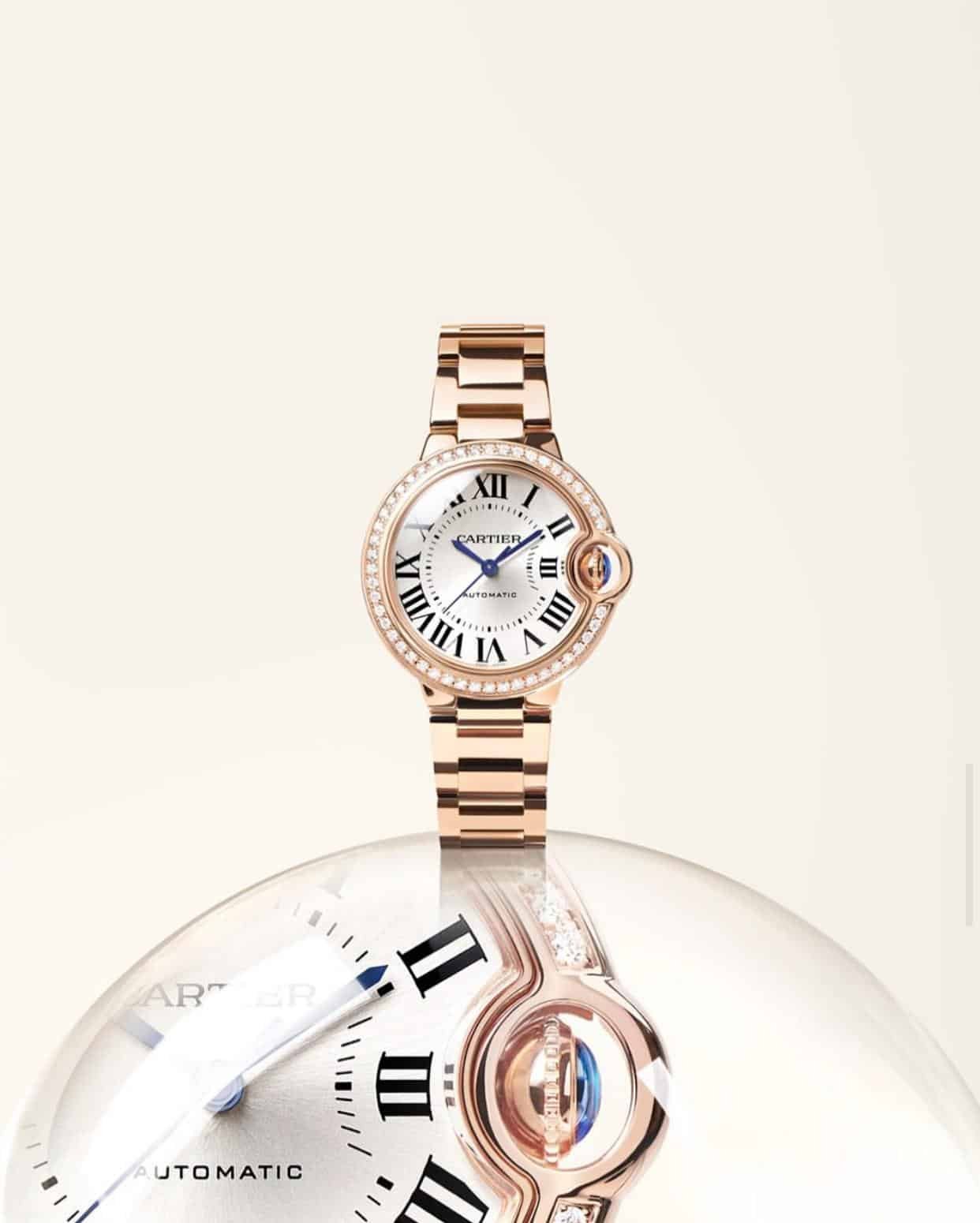
— Ballon Bleu: controlled curvature, optical balance
— Pasha: calibrated volumes, technical symmetry
In Tokyo, these geometries become indicators of coherence.
The light exposes every line, every angle, every ratio between surface and volume.
Nothing can hide.
2. The Movements — Mechanical Fidelity
Cartier High Watchmaking relies on movements designed to be:
— consistent,
— stable,
— technically clean,
— free of unnecessary decoration,
— aligned with a French logic of mechanical precision.
In Tokyo, this reliability is decisive.
Clients evaluate the coherence of the mechanism before the beauty of the dial.
A watch must fulfill its mechanical promise before expressing its style.
3. The Codes — Function Before Effect
At Cartier, the codes are not decorative.
They are structural.
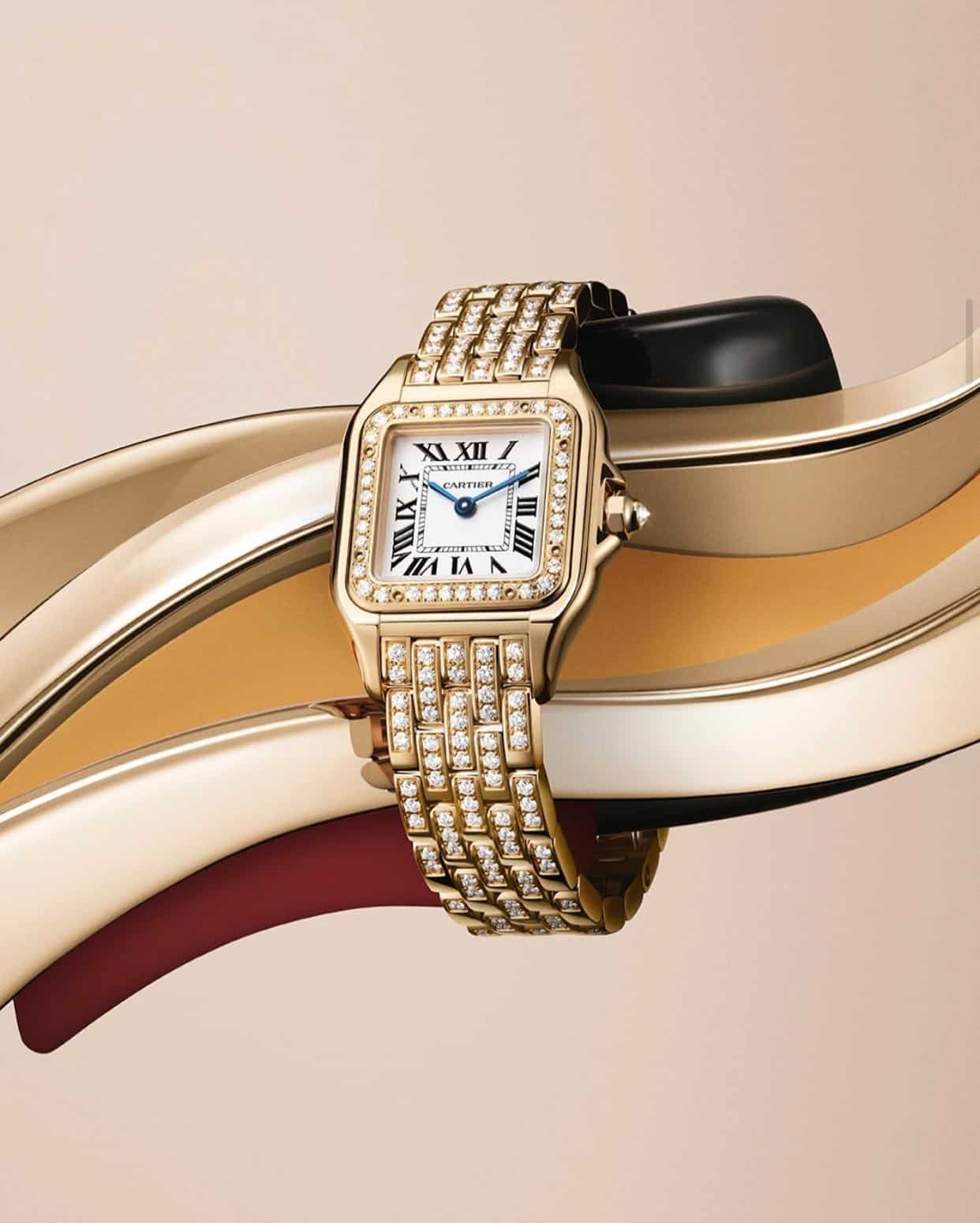
— Santos screws: true stability markers
— Sapphire crown: a visual point of balance
— Elongated indexes: accelerated reading
— Architectural cases: functional geometry
In Tokyo, these codes are understood as technical decisions, not ornaments.
· • • ·
Experience — The Wrist as an Analysis Surface
In Tokyo, trying on a Cartier watch feels like an audit.
The Japanese eye observes:
— the regularity of the seconds hand,
— the purity of the dial,
— the alignment of the indexes,
— the tension of the bracelet,
— the clarity of each chamfer,
— the overall balance of the case on the wrist.
This is not an impulsive purchase.
It is a structural validation.
A watch must be irreproachable to convince.
Cartier, with its architectural approach to watchmaking, meets this standard with unusual clarity.
· • • ·
Sustainability — The House’s Quiet Discipline
Responsibility in watchmaking isn’t stated.
It is demonstrated.
Cartier applies a sustainability logic grounded in:
— material optimization (cases, bracelets, components),
— metal traceability,
— reduced machining waste,
— specialized, tightly controlled workshops,
— long-term mechanical durability,
— continual refinement of manufacturing tolerances.
Tokyo understands this rigor.
Durability is perceived as a natural extension of precision.
· • • ·
Gloss Signature™ Conclusion
Cartier High Watchmaking in Tokyo is:
— mastered forms revealed by Japanese light,
— reliable, rigorous movements,
— disciplined mechanical craftsmanship,
— a functional reading of the House’s codes,
— responsibility integrated as method,
— a precision-driven aesthetic aligned with Japanese culture.
In Tokyo, Cartier is not viewed as a maison of style.
It is viewed as a set of controlled mechanical decisions.
The city demands exactness.
Cartier answers with precision.
· • • ·
© Cartier
© Cartier

© Cartier
© Cartier

© Cartier
© Cartier

© Cartier

© Cartier

© Cartier

© Cartier
© Cartier

© Cartier

© Cartier

© Cartier
FAQ — Cartier High Watchmaking Tokyo
· • • • ·
1. Why does Tokyo offer such a unique environment for Cartier High Watchmaking?
Because Tokyo does not see a watch as a symbol.
It reads it as a mechanical structure.
Under its cool, directional, perfectly neutral light, every detail becomes visible:
— an irregular angle,
— a misaligned index,
— an imprecise chamfer,
— a seconds hand lacking perfect regularity.
Tokyo tests a watch like an instrument.
It does not seek effect — it seeks stability.
Cartier High Watchmaking, built on geometry, disciplined movements, and controlled case architecture, aligns naturally with this visual method of evaluation.
Here, a watch is not “beautiful.”
It is correct — or it is not.
· • • • ·
2. How is Cartier High Watchmaking perceived differently in Tokyo compared with Paris?
In Paris, Cartier evokes line, allure, French sophistication.
The watch expresses aesthetic identity.
In Tokyo, the reading shifts entirely.
The watch is analyzed through:
— the discipline of the case,
— coherence of proportions,
— consistency of the movement,
— the functional logic of the codes (Santos screws, crown, curves, indexes).
Japanese light leaves nothing to interpretation.
It cuts volumes, reveals surfaces, exposes precision — or the lack of it.
Because Cartier builds on historic forms and stable mechanics, Tokyo finds a natural alignment.
Style becomes structure.
The watch becomes an object of analysis.
· • • • ·
3. How does Cartier select the movements presented in Japan?
Selection follows a strict logic:
a movement must remain reliable, consistent, and legible under every lighting condition.
Cartier prioritizes calibers that are:
— stable over time,
— free of unnecessary complications,
— clean in their architecture,
— executed with constant precision,
— consistent with the Maison’s French watchmaking identity.
Each movement is tested for:
— running regularity,
— instant legibility,
— its ability to keep visual identity under cool light,
— its dialogue with Tank, Santos, Ballon Bleu, or Pasha geometries.
The movement is never decorative —
it is functional.
Tokyo values exactly that.
· • • • ·
4. Why do Cartier’s iconic shapes resonate so strongly in Tokyo?
Because they function as structures, not styles.
— Tank: axis, proportion, logic, stability
— Santos: riveted construction, clear legibility, controlled tension
— Ballon Bleu: unified curvature, volume balance
— Pasha: symmetry, articulation, circular structure
Tokyo reads these watches as complete architectures.
Every angle, surface, and curve must respond to a precise intention.
This discipline, deeply rooted in Japanese culture, finds in Cartier a language immediately understood.
· • • • ·
5. How are Cartier watches built to achieve this level of precision?
Cartier’s workshops operate like calm engineering spaces.
Watchmakers work in:
— perfectly neutral light,
— total silence,
— millimetric zones of concentration.
Each watch follows an immutable sequence:
— case architecture,
— movement study,
— index alignment,
— hand setting,
— axis control,
— bracelet tensioning,
— multi-angle inspection,
— cold-light validation.
Nothing is rushed.
Nothing is approximate.
A single watch may require dozens of hours of micro-adjustment.
The result:
a piece defined not by display,
but by mastery.
· • • • ·
6. Why is silence essential in Cartier High Watchmaking?
Because a movement is regulated to the precision of a breath.
Silence allows the watchmaker to hear:
— the regularity of the tick-tock,
— friction on an axis,
— the stability of a gear,
— the exactness of alignment.
A stray noise distorts perception.
A loud environment can hide an irregularity.
Silence is not an ambiance.
It is a technical instrument —
and this aligns with Japanese culture’s operational calm.
· • • • ·
7. Are Cartier watches specifically adapted for the Japanese market?
No.
They are not modified — they are selected.
Tokyo demands:
— clean lines,
— perfect readability,
— mechanical stability,
— controlled proportions,
— coherence between volume and light.
The pieces presented are those that naturally pass this filter.
It is not adaptation.
It is technical curation.
· • • • ·
8. How does Cartier High Watchmaking express itself in Tokyo spaces like Ginza and Omotesandō?
These spaces impose ultra-regulated presentation:
— minimalist vitrines,
— analytical white light,
— exact distances,
— complete silence.
In such conditions, a Cartier watch does not seduce through shine.
It convinces through:
— clarity of form,
— coherence of the case,
— consistency of the movement,
— accuracy of proportions.
The watch is not “enhanced.”
It is revealed.
Tokyo reads every detail.
And Cartier withstands this scrutiny.
· • • • ·
9. Is a Cartier watch designed to be worn or displayed?
Worn — but worn with intention.
A Tank is not a rectangle.
It is a controlled line.
A Santos is not an icon.
It is a structure of balance.
A Pasha is not a circle.
It is functional geometry.
Cartier designs watches that live:
they reveal themselves in movement, accompany gesture, express attitude.
They can be displayed — their architecture supports a museum-level reading —
but their true destination is the wrist, not the showcase.
· • • • ·
10. Does Cartier High Watchmaking Tokyo align with the Gloss City matrix (50% luxury / 30% craftsmanship / 20% sustainability)?
Yes — fully.
50% Luxury
Geometry, discipline, readability — a luxury of exactness, not effect.
30% Craftsmanship
Ultra-precise adjustments, case architecture, mechanical control, millimetric execution.
20% Sustainability
Certified materials, optimization of components, reduction of material loss, coherent production, real mechanical longevity.
Cartier High Watchmaking Tokyo expresses the Gloss City model clearly:
structured luxury, disciplined craftsmanship, integrated responsibility.
· • • • ·
CARTIER
© Cartier